AI scriptwriting for video: Write better scripts faster
You have 15 seconds to hook someone. That's it.
After 15 seconds, most people click away from your video. They're watching on their phone while scrolling. They don't care if the rest of your video is perfect. If those first 15 seconds don't work, they're gone.
This is why script matters. A great script turns browsers into viewers. A bad script turns viewers into exes.
Here's the problem: Writing a good script is hard. It's not the same as writing blog posts. It's not the same as writing email. Video has its own rules.
This is where AI scriptwriting comes in. I'll show you how to write better scripts faster using AI.
Why your script matters more than you think
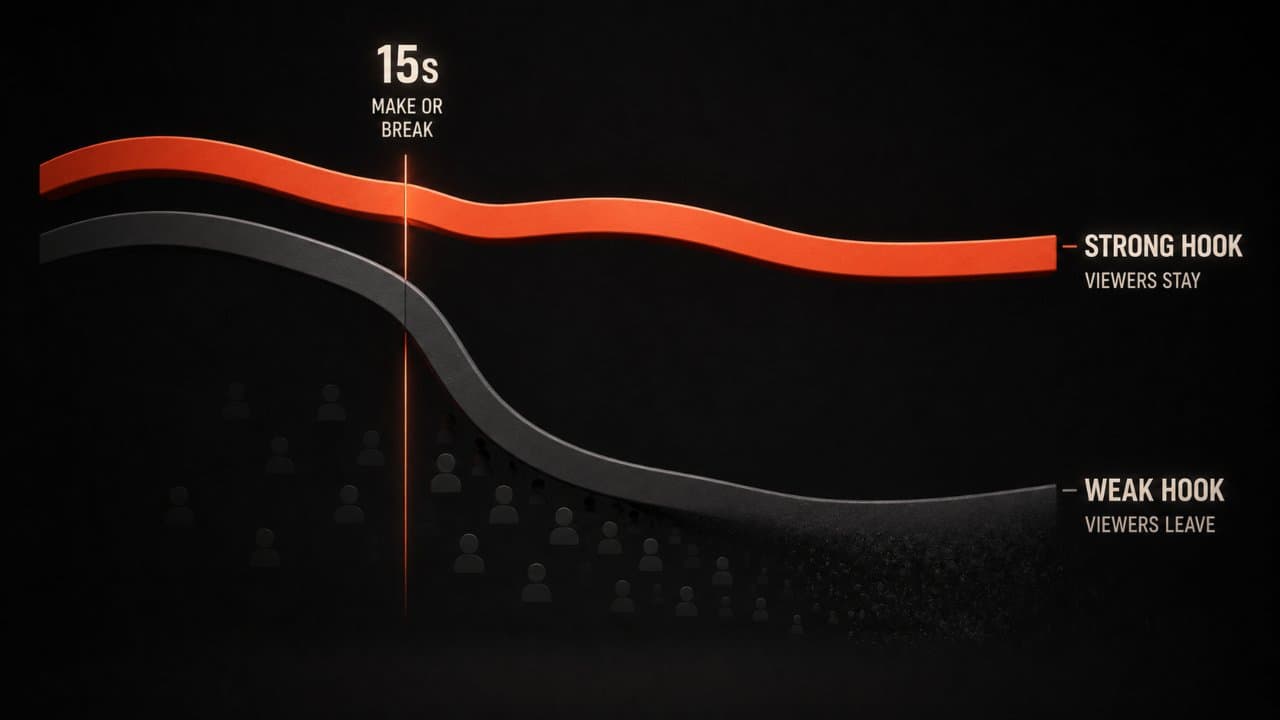
Let me show you with data.
A video with a weak hook loses 40% of viewers in the first 15 seconds. A video with a strong hook keeps 80% of viewers past 15 seconds.
That's not a small difference. A strong hook doubles your engagement just by keeping people watching instead of clicking away.
Now multiply that across multiple effects. Strong hook keeps people watching. Strong story structure makes people stay to the end. Clear call-to-action makes people click. One weak script costs you 60% of your potential engagement.
Here's the second reason script matters: Completion rate.
Videos with clear structure have 50% completion rate (people watch to the end). Videos with rambling, unclear structure have 15% completion rate.
That's the difference between engagement that helps SEO and engagement that doesn't. Google cares about completion rate. Higher completion rate means higher rankings, a key factor in any video SEO strategy.
Your script determines completion rate. AI helps you write the script that keeps people watching until the end.
How AI scriptwriting works
AI scriptwriting works in three main ways.
Method 1: From a prompt
You describe your video in a sentence or two. AI writes the script.
Example: You type "Explain how to backup your files to the cloud in 2 minutes."
AI returns a full script with opening hook, main points, and closing call-to-action.
Method 2: From existing content
You paste a blog post. AI converts it to a video script.
This is powerful because you're not starting from scratch. AI reads your blog post and extracts the key points. Converts them into conversational language. Adds a hook and call-to-action.
Method 3: Format adaptation
You have a script for a 5-minute video. You need a 30-second version for TikTok.
AI takes your script and condenses it. Keeps the essential parts. Removes filler. Creates a tight 30-second script.
Or vice versa. You have a 30-second script and need 3 minutes for YouTube. AI expands it with examples and detail.
Prompting techniques for better scripts
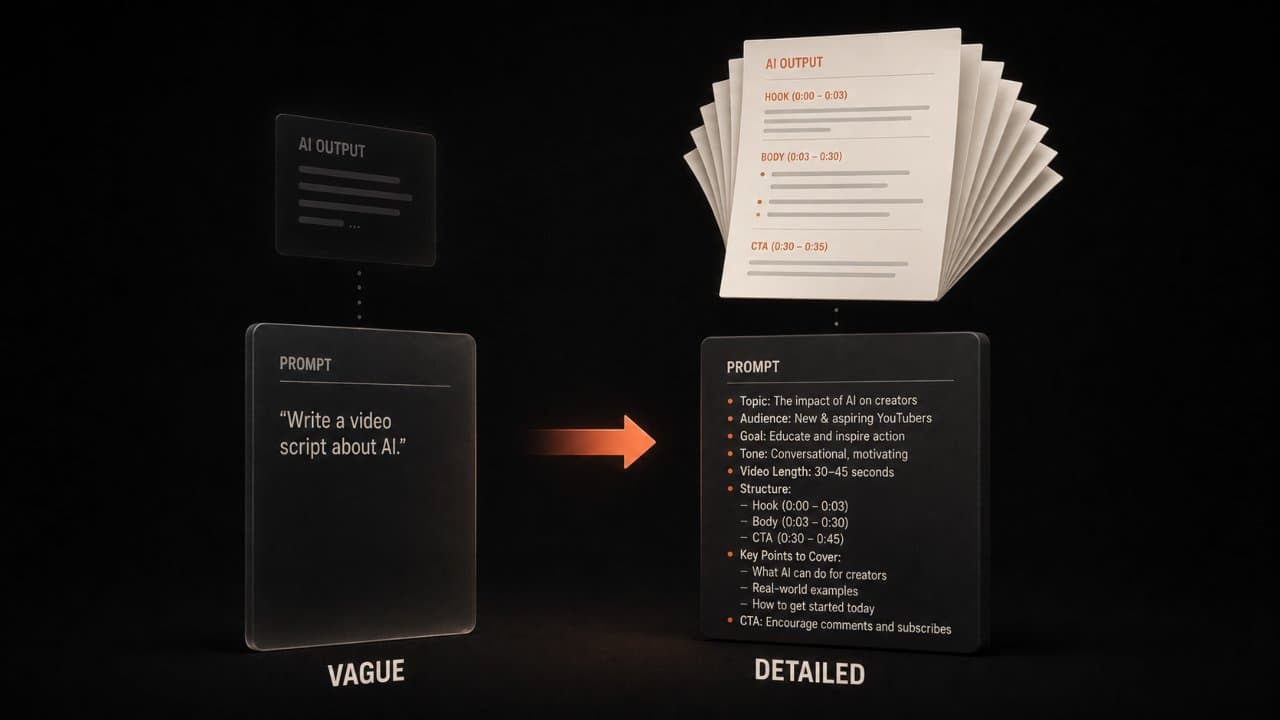
Here's where most people mess up with AI. They write a bad prompt and get a bad script.
The quality of your script depends on the quality of your prompt.
Bad prompt: "Write a video script about email marketing."
Good prompt: "Write a 3-minute video script about email marketing for small business owners. The hook is 'Email marketing beats social media for ROI.' The main point is three email sequences that increase sales. The target is beginners, not experts. Use a friendly, casual tone. End with a link to our free email guide."
The difference is specificity. You're not just asking AI to write something. You're telling AI exactly what you want.
Here's the formula for a good prompt:
[Length] video script about [topic] for [audience]. Hook: [opening statement]. Main points: [bullet list]. Tone: [casual/professional/funny]. Call-to-action: [what should they do].
Example with real numbers:
2-minute video script about AI video for marketing teams. Hook: 75% of marketing videos will be AI-generated by end of 2026. Main points: (1) AI video saves 90% of production time, (2) AI video reduces costs by 80%, (3) your competitors are already using it. Tone: direct, no fluff. Call-to-action: download our free AI video benchmark guide.
AI reads this and writes a script that matches exactly what you need.
Advanced prompting technique: Iteration
Your first AI script probably isn't perfect. That's normal.
Let's say AI writes a script that's 4 minutes long but you need 2 minutes.
You tell AI: "This script is too long. Cut 50% while keeping the hook and main points."
AI shortens it.
You watch the video. The transitions feel abrupt.
You tell AI: "Add 2-3 smooth transitions to improve flow."
AI adds them.
This iterative approach is how you end up with great scripts. You're not getting it right the first time. You're collaborating with AI to refine it.
Script templates by video type
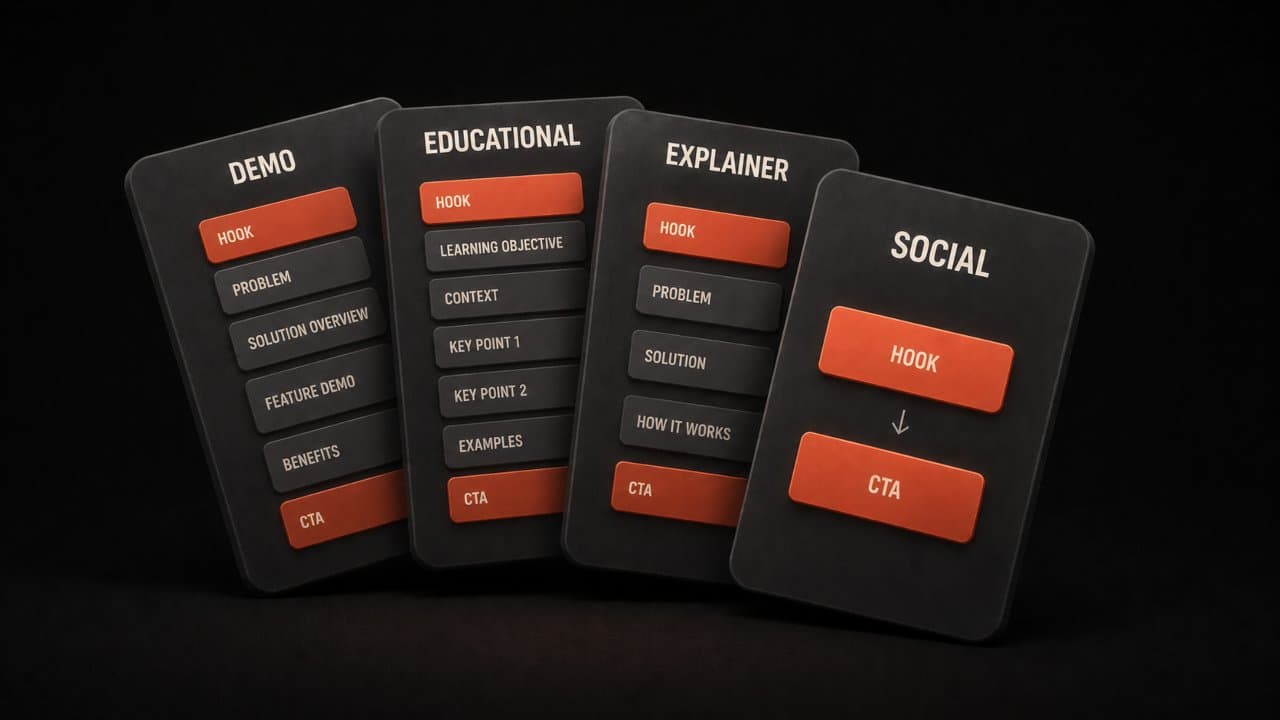
Every video type needs different structure. AI should write structure-specific scripts.
Social media videos (15-30 seconds)
Hook (2 seconds): Strong opening that makes people stop scrolling.
Benefit (5 seconds): Why should they care? What do they get?
Proof (5 seconds): Show, don't tell. Quick example or demo.
Call-to-action (3 seconds): Like, follow, click link.
Total: 15 seconds.
Example prompt: "Write a 30-second TikTok script about productivity tips. Hook: 'This simple trick saved me 5 hours per week.' Main points: (1) the trick, (2) how to do it, (3) result. Tone: energetic, speak directly to camera. Call-to-action: follow for more tips."
Explainer videos (2-3 minutes)
Problem (20 seconds): Here's what's wrong with the status quo.
Solution (40 seconds): Here's a better way.
Benefits (40 seconds): Here's why this is better.
Proof (20 seconds): Examples or case studies.
Call-to-action (20 seconds): Here's what to do next.
Total: 3 minutes.
Example prompt: "Write a 3-minute explainer video about why companies should use AI video generation. Problem: video production is expensive and slow. Solution: AI handles it in minutes, not weeks. Benefits: save money, create more content, scale faster. Proof: 91% of businesses now use video, 75% is AI-generated. Call-to-action: Try DeepReel free. Tone: professional but conversational."
Educational videos (5-7 minutes)
Introduction (30 seconds): What will you learn? Why should you care?
Concept 1 (60 seconds): Explain first idea with examples.
Concept 2 (60 seconds): Explain second idea with examples.
Concept 3 (60 seconds): Explain third idea with examples.
Application (90 seconds): How to actually use this. Step-by-step example.
Summary (30 seconds): Recap the three concepts.
Call-to-action (30 seconds): Next steps.
Total: 6 minutes.
Example prompt: "Write a 6-minute educational video script about copywriting for beginners. Introduce what they'll learn: three principles of persuasive copy. Concept 1: Clarity. Concept 2: Specificity. Concept 3: Emotion. Application: Show how to apply all three to a product description. Use simple language. Include real examples. Tone: encouraging, like a teacher, not salesy. Call-to-action: Take our free copywriting quiz."
Product demo videos (2-3 minutes)
Problem (20 seconds): What are customers struggling with?
Product intro (20 seconds): Introduce your solution.
Feature 1 demo (30 seconds): Show first feature in action.
Feature 2 demo (30 seconds): Show second feature in action.
Feature 3 demo (30 seconds): Show third feature in action.
Benefits summary (20 seconds): Why this matters.
Call-to-action (30 seconds): How to get started.
Total: 3 minutes.
Example prompt: "Write a 3-minute product demo script for project management software. Problem: Teams are drowning in emails and spreadsheets. Solution: centralized project management. Feature 1: Task assignment. Feature 2: Timeline view. Feature 3: Team collaboration. Benefits: save time, stay organized, communicate better. Call-to-action: Start free trial today. Tone: excited but professional. Show each feature with actual product screenshots."
Common scriptwriting mistakes
These mistakes come up constantly.
Mistake 1: Starting with explanation instead of problem
Bad script starts: "Let me explain how our software works..."
Good script starts: "You spend 3 hours per week on admin work you hate."
The second one gets attention. The first one is boring.
Mistake 2: No clear structure
You ramble. You mention different points in random order. You go back to earlier points halfway through.
People get lost. They stop watching.
AI is good at imposing structure. Use it.
Mistake 3: Assuming viewers know the context
You reference something from five minutes earlier. Viewers forget. They're confused.
Repeat yourself. Remind viewers of the main point throughout the video.
Mistake 4: Ignoring the platform
A TikTok script sounds different than a YouTube script. Adding subtitles also varies by platform. YouTube viewers tolerate longer intros. TikTok viewers need the hook in 3 seconds.
AI can adjust tone based on platform if you tell it.
Mistake 5: No call-to-action
Your video ends and viewers go "now what?" You didn't tell them. They do nothing.
Every script needs a clear call-to-action. Click the link. Download the guide. Subscribe. Sign up. Something.
Using AI scriptwriting platforms
You don't need specialized software. ChatGPT and Claude work fine for scriptwriting.
But some platforms are optimized for this specific task.
Option 1: ChatGPT
Costs: $0 (free tier) or $20/month (ChatGPT Plus).
Strength: Good at longer scripts. Understands context. Quick iteration.
Weakness: Takes more back-and-forth to get exactly what you want.
Option 2: Claude
Costs: $0 (free at claude.com) or $20/month (Claude Pro).
Strength: Excellent at structured formats. Very detailed scripts. Good at understanding nuance.
Weakness: Can be more verbose than needed.
Option 3: Fliki
Costs: Free tier or $8-88/month.
Strength: Built specifically for video script generation. Quick templates. Paired with video generation.
Weakness: Less flexible than general AI tools. Templates limit creativity.
Option 4: Copy.AI
Costs: Free tier or $44/month.
Strength: Templates for different script types. Easy to use. Fast.
Weakness: Scripts can feel template-y. Less personalization.
My recommendation: Start with free ChatGPT. Write five scripts. See what you like and don't like. Then decide if you need a paid tool.
For most people, ChatGPT is enough.
The script-to-video workflow
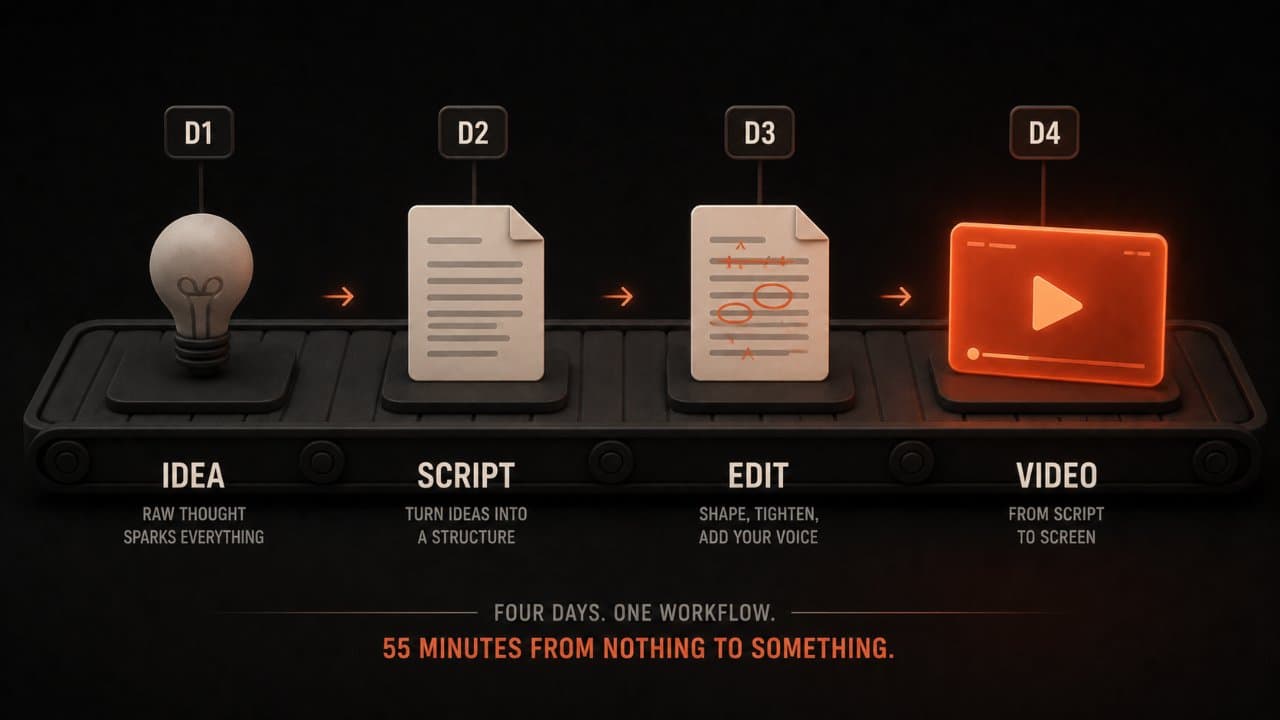
Here's how to use AI scriptwriting in your actual workflow.
Day 1: Write or collect your idea (15 minutes)
What's your video about? Jot down the topic, audience, and main point.
Day 2: Generate the script (15 minutes)
Use the prompt formula from earlier. Paste it into ChatGPT or Claude, or use a dedicated AI video script generator. Get back a full script.
Day 3: Edit and refine (15 minutes)
Read the script out loud. Sounds weird? Fix it. Too long? Cut it. Not persuasive enough? Tell AI to punch it up.
Day 4: Generate the video (10 minutes)
Paste the script into your AI video tool (DeepReel, HeyGen, etc.). Generate video. You're done.
Total time: 55 minutes from idea to finished video.
A human scriptwriter would charge $500-1,000 and take a week. You just did it in under an hour.
Why AI scripts work better
This might sound counterintuitive, but AI scripts are often better than what humans write in a rush.
Here's why:
AI doesn't ramble. Humans write conversationally and end up with filler. AI writes tight.
AI follows structure. Humans skip around. AI understands that videos need beginning, middle, end.
AI repeats key points. Humans mention something once. AI knows repetition helps viewers remember.
AI uses simple language. Humans try to sound smart. AI focuses on clarity.
None of this is magic. It's just following the rules of good copywriting consistently.
FAQ
Should I write my own script or use AI?
Use AI as first draft. Then edit it. Your script will be 80% as good as hiring a copywriter but take 80% less time. Use AI to get to 80%. If you need the final 20%, hire an expert.
How many times should I iterate on a script before filming?
Two or three times. AI generates script. You edit once. You test the script by reading it out loud or with an actor. You edit again based on how it sounds. Then you film. More iterations mean diminishing returns.
Can I use the same script for multiple platforms?
No. A YouTube script won't work for TikTok. A professional tone won't work for Instagram Reels. You need platform-specific scripts. AI can adapt your script to different platforms if you ask. Takes five minutes per adaptation.
What if I don't have a script at all? Should I improvise?
Don't improvise. People who improvise usually ramble. Their videos are longer and less engaging. AI scriptwriting is so fast that there's no excuse to wing it. Five minutes with AI gets you better results than 20 minutes of improvisation.
Wrap up
Write down one video idea. Use the prompt formula from this article. Generate a script with DeepReel or ChatGPT. Read it out loud. Edit anything that sounds off. That's your first AI script, and it takes 20 minutes.
Need more inspiration? Browse our AI video prompts collection to jumpstart your next script.