AI Video for Coaches and Consultants: Scale Your Expertise
Your best asset isn't your credentials or your certifications. It's your ability to solve problems for your clients. So why does it take so long to reach them?
Most coaches and consultants spend their days saying the same things to different people. A business coach answers "How do I price my service?" five times a week. A fitness coach explains proper form for the same three exercises to new clients every Monday. A marketing consultant walks prospects through their 10-step sales framework over and over again.
That's knowledge that's trapped in one-on-one conversations. It doesn't scale. Your time is finite. Your income is capped. Your impact is limited to the number of hours you can work.
What if your best advice wasn't locked in your calendar?
AI video changes that equation. You record your framework once, explain it once, demonstrate it once. Then you turn it into training content, course material, client onboarding videos, marketing assets, and community engagement tools. One piece of knowledge becomes a hundred touchpoints.
Let's talk about why video works for coaches, how to build a content library that serves your business, and which tools actually deliver results in 2026.
Why coaches need AI video at scale
The coaching industry has a trust problem. Not because coaches aren't trustworthy. The problem is that prospective clients can't feel that trust until they meet you.
A potential client sees your website. They like your testimonials. But they don't know how you think. They don't know your communication style. They don't know if your advice actually resonates with them. That gap between "seems qualified" and "I trust this person" is where you lose deals.
Video closes that gap.
Studies show that 80% of consumers say they're more likely to buy from a brand after watching a video. But coaching isn't a transaction. It's a relationship. For coaches, the numbers are even stronger. Video builds familiarity and credibility faster than any sales page.
Here's what happens when prospects watch your coaching video. They see how you think. They hear your voice. They sense your energy and whether you actually care about solving problems versus just collecting a fee. If they like what they see, they book a call. If they don't, you've saved everyone time.
That's only the beginning. Video doesn't just sell coaching. It replaces some coaching.
A prospect watches your 10-minute video on "How to Price Your Consulting Services Without Leaving Money on the Table." They get real value. They can apply three of your principles immediately. Now when they ask to work with you, they're already invested in your thinking. They've already seen you work. They know what they'll get. The sales conversation becomes easy.
But the real power comes from what your prospects don't ask about.
Every coaching client asks the same foundational questions. How do I get my first client? How do I set my rates? How do I scale to multiple revenue streams? If you answer these questions in video form (in your course, in your onboarding, in your community) you're doing less explainer coaching and more strategic coaching. You charge more for strategic work. You work with fewer, better-fit clients. Your business gets more profitable.
Clients who watch onboarding videos are 57% less likely to churn and complete onboarding 54% faster. For coaches selling ongoing programs, that's the difference between 70% completion rates and 95% completion rates. That's the difference between a successful cohort and a failed one.
The numbers make the case. Video converts prospects into clients faster. It keeps clients engaged longer. It replaces lower-value one-on-one time with higher-value strategic work. For a coaching business, that adds up fast.
Use cases: where AI video solves your real problems
Video for coaches isn't a nice-to-have. It solves specific, painful problems in how coaching businesses operate. Here are the use cases that actually matter.
Course content and online programs
The fastest way to scale your coaching is to package it. Online courses are where coaches go to reach more people without adding hours to their calendar.
Most coaches start with recorded content and realize they're just uploading phone recordings or rough Zoom sessions. The audio is bad. The video quality is poor. The energy is flat. Students watch the first 30 seconds and stop.
AI video lets you create professional course content at the speed of thought. You talk through a lesson. DeepReel's AI avatar speaks it back, on-brand, with your tone. You add graphics, change the background, adjust the pacing. In 20 minutes, you have course-quality video. In a week, you have 10 lessons. In a month, you have a complete course.
The production timeline shrinks from months to weeks, the cost drops compared to hiring video editors, and the output stays consistent across every lesson.
Courses with video see 3x higher completion rates than courses with text and PDFs. For coaches selling courses, that's the difference between an asset that works and an asset that sits empty.
Client onboarding and first-week success
Your first coaching call with a new client is the most expensive hour you work. You're answering logistics questions (When do we meet? What should I prepare?). You're building rapport. You're learning their situation.
None of that is unique to them. None of that requires your actual expertise.
Onboarding videos remove the expensive logistics conversation. Your new client watches three videos on their first day: how your coaching program works, what to prepare for your first session, and what you expect from the client. They've learned more than they would in a 30-minute call. You jump straight to strategic work.
DeepReel videos work particularly well here. You create three 5-minute onboarding videos once. New clients watch them when they buy. You save 10-20 hours a month on repeated orientation conversations. That time goes toward actually coaching.
Even better: clients who watch onboarding videos show up more prepared. They ask better questions. Your coaching sessions go deeper faster. Everyone wins.
Marketing videos that build authority
Coaches rely on trust to sell. The fastest trust-builders are videos where you teach something useful.
A 3-minute "How to Raise Your Rates Without Losing Clients" video teaches strategy and shows your thinking. A prospect watches it, learns one concrete tactic, and thinks "I want to work with this person." Most sales pages get 2% conversion. Educational videos on LinkedIn or YouTube get views, shares, and genuine interest.
This is where creating a content library becomes a business lever. You create 50 teaching videos. You distribute them across YouTube, LinkedIn, email, and your website. Each video brings leads. Over time, that's hundreds of qualified prospects who've already decided they like your approach.
The cost? Hours once to record and one tool to convert to video. The return? Months of lead generation with zero additional effort.
Community engagement and group coaching
Coaches are increasingly selling group programs and communities. These programs live or die on engagement.
A community that just has text discussions feels dead. A community with weekly videos from the coach feels alive. Members watch your weekly guidance video, see your face, feel your energy, and stay engaged.
Group coaching works better with video because members stay accountable. They watch the Friday training video. They do the homework. They show up Monday ready to work.
For cohort-based courses and membership programs, video is the difference between 40% engagement and 80% engagement.
How to build an AI video content library that works
Most coaches approach video like a one-time project. Record some content. Upload it. Move on.
That doesn't work. Video scales when you treat it like a system.
Here's how top coaches think about building a content library.
Start with your FAQ. What do you answer most in discovery calls? What do every new client ask? Write down the 20 questions your prospects always ask. Pick the 10 most valuable ones. That's your content library foundation.
Batch your recording. Don't record one video per week. Set aside four hours. Record 10-15 quick takes on different topics. Talk naturally. Explain your frameworks. Demo your process. Don't worry about production quality. That's what AI is for.
Convert to professional video. Run your raw video through DeepReel. It cleans up the audio, standardizes the look, adds your branding. What took an hour to record becomes a professional video in minutes.
Organize by value chain. Don't just dump videos on YouTube. Create a journey. Awareness videos (your teaching content) feed to consideration videos (how you work) feed to decision videos (client results) feed to onboarding videos (success framework). This path converts better than random uploads.
Repurpose relentlessly. One video becomes a YouTube short, a LinkedIn post, an email sequence, and course content. One video becomes three social media graphics and a blog post transcript. One video becomes five pieces of marketing content. That's where video becomes cost-effective.
Update and refresh. A video about "Five Steps to Land Your First Consulting Client" is still valuable in 2030. But you'll want to update examples, pricing, and platforms. DeepReel makes it easy to refresh videos without re-recording.
The coaches making the most money from video aren't the best at filming themselves. They're the best at thinking systematically about what knowledge matters most and turning it into evergreen content.
Turning one-on-one advice into video courses
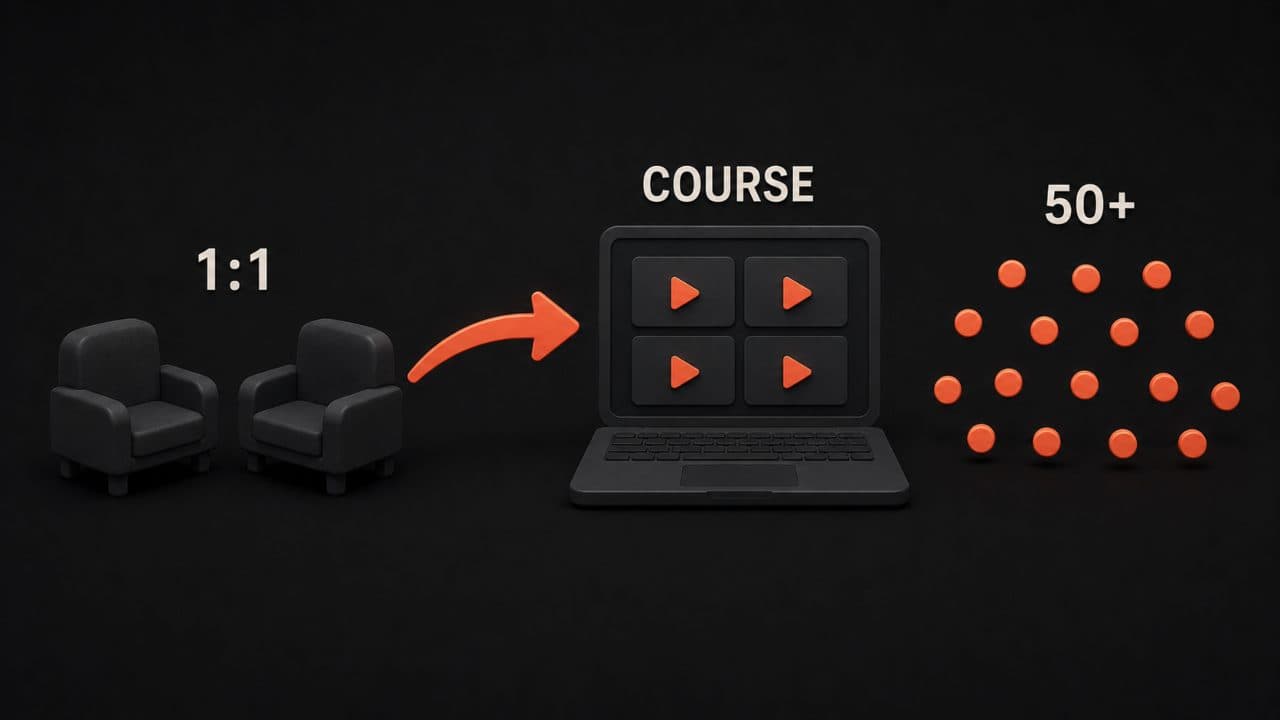
Here's the real prize: scaling your 1:1 income into course income.
Most coaches start with 1:1 coaching because it pays immediately. You work with five clients. You make $5,000-$50,000 a month. That's good money. But it doesn't scale beyond your hours.
A coaching course scales. You work with 50 students. You make $5,000-$50,000 a month with less than 20% of the effort.
The conversion path looks like this.
You take your most successful 1:1 coaching relationships. What was the actual sequence of frameworks, lessons, and breakthroughs? What did 80% of your clients need to learn? Distill that into 12-15 core lessons.
Now, turn each lesson into a video. Not a 60-minute talking-head performance. A 7-10 minute structured video that teaches one core idea. Walk through the framework. Show an example. Explain what your students should do this week.
DeepReel works well here because you can maintain your personal brand and voice without needing to sit and record 15 videos in a studio. You explain it once. The AI avatar presents it professionally. You add graphics and examples. Your course is done.
The next step is critical: structure the course for results. Coaching courses succeed when students actually do the work. That means clear assignments, accountability checkpoints, and peer interaction.
Video teaching handles the "here's the framework" part. Assignments, templates, and community handle the "here's how you apply it" part. Together, they create the results that lead to powerful video testimonials and word-of-mouth referrals.
A coaching course that gets results sells itself. Your first 10 students succeed. They tell their network. Your second cohort is full before launch. That's how coaches go from trading hours for money to selling digital products.
Choosing the right tools
You have several options for converting your coaching knowledge into video. Here's what works best in 2026.
DeepReel
DeepReel is purpose-built for coaches and consultants. You talk through an idea. The AI avatar speaks it back with professional presentation. You add your branding, choose your avatar, adjust the pacing, and you have course-ready video.
The interface is fast and intuitive. You don't need a technical background. You record voice, or you paste a script, and DeepReel handles the video generation.
Pricing is three tiers: $5/month (100 video credits), $25/month (1,000 credits), or $30/month (3,000 credits). Most coaches operate on the $25 plan, generating 20-50 videos per month. That's eight to ten courses per year.
DeepReel's big advantage for coaches: the output looks polished and professional. New clients and course students assume you hired a production company. You didn't. You used AI. The perceived value is much higher than the actual investment.
Synthesia
Synthesia is an AI video platform built for businesses that need to scale video content. They offer multiple avatar options, text-to-speech in 140+ languages, and more customization than most tools.
Synthesia works well if you're creating videos in multiple languages or want extreme control over every element. The learning curve is steeper than DeepReel, but the output quality is excellent.
Loom
Loom started as a screen recording tool but has evolved into a full video platform. You record yourself. Loom adds editing tools, sharing features, and analytics.
Loom works for coaches who like recording themselves but want faster editing and easier distribution. It's not AI generation—it's recording plus AI enhancement.
Descript
Descript is a video and podcast editor that works like a document. You can edit video by editing text, remove filler words with one click, and generate text-to-speech narration.
Descript works best for coaches who have lots of existing content and want to batch-edit and repurpose it. The AI narration option is great for updating old videos or creating variations quickly.
Opus Clip
Opus Clip automatically turns long videos into short clips optimized for social media. If you're creating course content and want those videos to also drive awareness on TikTok, Instagram Reels, and YouTube Shorts, Opus Clip saves hours of manual editing.
For most coaches starting out, DeepReel is the fastest path to professional video at scale. It requires no recording ability, no technical skills, and no video editing experience. You talk or type. It creates video. You ship it.
Building recurring revenue from your expertise
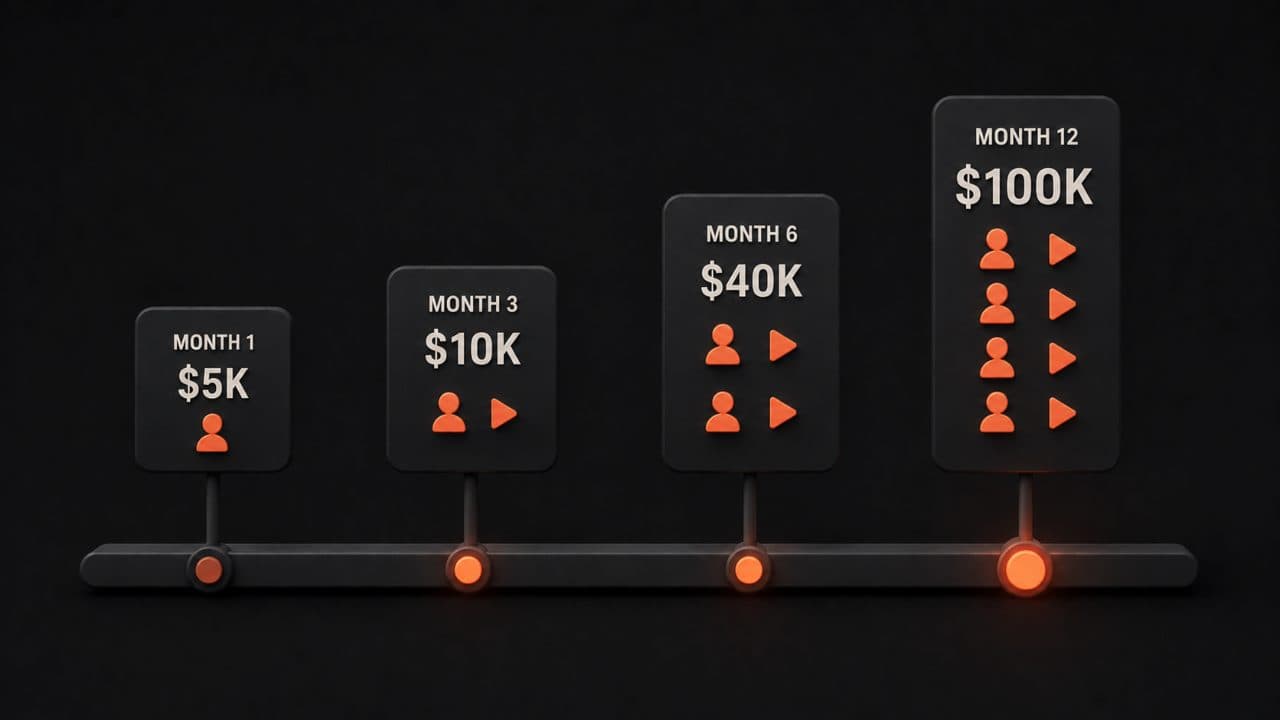
Here's why this matters for your business model.
A coaching business built purely on 1:1 work has limited growth. You can raise your rates. You can work more. But you're always trading hours for income. If you get sick, stop working, or want to take a vacation, your revenue stops.
A coaching business with a video library and online courses has diversified revenue.
- Month 1: You have 1:1 clients. They pay $2,000-$5,000/month for ongoing coaching. You work 20 hours a week.
- Month 3: You launch your first course. It sells to 10 students at $497 each. That's $4,970 in revenue with minimal additional hours.
- Month 6: You run your second cohort. Now you have 15 active 1:1 clients ($30,000+) plus two courses generating $10,000/month. Your business generates $40,000/month, and you're working 30 hours a week instead of 50.
- Month 12: You have a catalog of four courses. Each one generates $5,000-$8,000/month in recurring revenue. Add your 1:1 coaching and you're running a $70,000-$100,000/month business without working more hours.
That's not fantasy. That's the path most successful coaches follow. The gap between coaches earning $50,000/year and coaches earning $500,000/year is often just one course and one community.
Video is how you build that without doubling your hours.
Monetization: five ways video increases your revenue
Video doesn't just improve your coaching. It changes your business model.
1. Higher-priced 1:1 coaching. Coaches with strong video presence charge 50% more for 1:1 work. Why? Because prospects have already seen you teach, explain, and solve problems. They know what they're getting. The sales conversation takes 20 minutes instead of two hours. You close 80% of conversations instead of 40%. For the outreach sequences that get prospects to those conversations, AI sales video covers the full playbook.
2. Group coaching and cohort programs. You can't scale 1:1 coaching beyond 15-20 clients. You can scale group coaching to 100-200 clients. Video is the medium that makes group coaching work. Your weekly training video keeps the group cohesive and engaged.
3. Self-paced online courses. This is where scaling happens. You create a course once. It sells for five years with zero additional effort. Most coaches price courses at $297-$997 depending on depth and scope.
4. Membership communities. Coaching communities with video thrive. Members watch your weekly guidance videos, complete assignments, show progress, and engage with each other. Most coaches charge $99-$297/month for membership. With 50-100 members, that's $5,000-$30,000/month in recurring revenue.
5. Corporate workshops and training. If you work with businesses (B2B coaches, executive coaches, corporate trainers), your video library becomes your calling card. You can sell day-long workshops, team training, and certification programs because you've already proven you know your material. Video builds that credibility.
The coaches who win are the ones who use video to shift from "I am my business" to "My business is my work." Video makes that possible.
Getting started: your first 30 days
You don't need to build 100 videos. You don't need to launch a complete course. You need to start.
Week 1: Plan. List the 10 questions your prospects always ask. Pick the top three. Write a 500-word script answering each one.
Week 2: Record. Set aside two hours. Record yourself answering each question in a natural, conversational way. You don't need a studio. Your phone is fine. Speak naturally.
Week 3: Convert. Upload your recordings to DeepReel. Create professional videos in 20 minutes. Choose your avatar, adjust the background, add text overlays.
Week 4: Deploy. Post your three videos on YouTube and LinkedIn. Link them in your email signature. Email them to your newsletter list. Mention them in your next discovery call with a prospect.
That's your first month. Three videos. No fancy equipment. No production company. No expensive editing software.
The second month, you do the same. Three more videos. By month six, you have 18 videos answering your most common questions. By month twelve, you have a library of 36 videos.
At month twelve, you launch your first course using six of those videos. You run a cohort for eight weeks. Twenty people sign up at $297 each. That's $5,940 in revenue you didn't have before.
In month 18, you run that course again. Twenty more students. Another $5,940. Meanwhile, you're working the same number of hours coaching, but your income grew 10%.
That's how video compounds. Our AI video small business guide covers more scaling strategies for solo operators.
FAQ
How long should coaching videos be?
For teaching content and courses: 7-10 minutes is ideal. Long enough to explain something meaningful. Short enough that people actually finish. For onboarding: 3-5 minutes. For marketing content on social: 30-90 seconds. For community engagement: whatever length tells the story. Your weekly group coaching video might be 20 minutes.
Do I need to be on camera?
No. AI avatars work just as well for courses and onboarding. They work well for teaching content. The only place where your face matters is in marketing and connection videos. Even there, an AI avatar that speaks with your voice works fine.
How many videos do I need to launch a course?
Start with six to eight core lesson videos. If you have good assignments and community, that's enough for a compelling 6-8 week course. Don't wait until you have 20 videos. Imperfect action beats perfect planning.
Can I use the same video library for multiple courses?
Absolutely. One video can be lesson 2 in your foundational course and bonus content in your advanced course. You're repurposing the same intellectual property across multiple products.
Wrap up
AI video turns coaching expertise into assets that work without you. You record your frameworks once, convert them into professional content with DeepReel, and deploy them across courses, onboarding, marketing, and community engagement.
Start with three teaching videos this week. Post them to YouTube and LinkedIn. By month six, you'll have a content library that generates leads and course revenue on its own.