AI Pitch Video: Win Investors with Compelling Presentations
You're in a room with five investors. You have 10 minutes. Your PowerPoint is open. Your hands are shaking.
Or maybe you're sitting at home, sending a pitch deck to a fund you've never met face-to-face. Either way, you're competing for attention in an inbox with thousands of other founders. Text PDFs, static slides, and email copy blur together. Investors see so many pitch decks they stop really reading them.
But what if your pitch was a video? What if the first thing that VC sees when they open your email is your face, your voice, and your story told with motion, energy, and conviction? That's the power of an AI pitch video. If you're already using video for closing deals, our guide on AI-powered sales videos covers the broader sales use case beyond fundraising.
Here's what we'll cover: why investors respond to video pitches, how to structure a compelling video pitch, the tools that make production fast and professional, proven strategies for distribution, and common mistakes that kill pitch videos before they get a second watch.
Why AI pitch videos win (and decks lose)
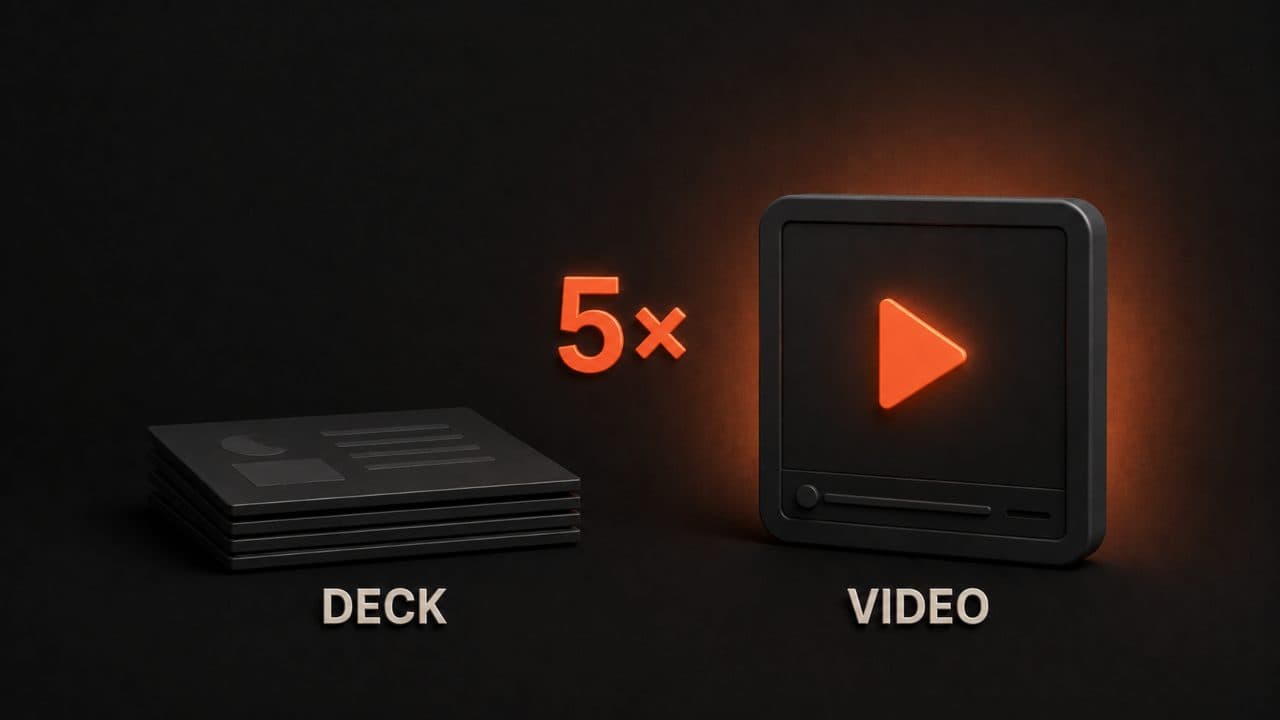
The numbers don't lie. Investors still get pitch decks. Stacks of them. Hundreds per week if they're managing a fund. Most go unread past slide three.
Video shifts the odds. A study by HubSpot found that 92% of marketers say video is an important part of their marketing strategy, and this applies equally to pitch videos. When a founder records themselves pitching their company, investor engagement shoots up.
Why? Because video does something a PDF can't do: it sells you.
First, video brings humanity. When investors see your face, hear your tone, and watch your body language, they're not just evaluating your business idea. They're evaluating you as a founder. Can you communicate clearly? Do you believe in what you're building? Are you the kind of person they want to bet on? A deck can't answer those questions. A video can.
Second, video is memorable. Investors watch hundreds of pitches. Your pitch deck looks like 47 others, same fonts, same structure, same bullet points. But your video? That's different. They remember it. According to Wistia research, 80% of viewers recall the key message of a video they watched, while only 20% remember what they read.
Third, video breaks through the noise. Email inboxes are crowded. Links to decks get buried. But a video that plays inline or auto-starts in an email? It demands attention. It takes seconds to get your message across instead of asking someone to download, open, and read a 20-page deck.
Fourth, video shortens the decision cycle. An investor watching a two-minute pitch video learns more than they would scrolling through slides. They see your product demo, your traction, your team, and your ask, all in context, with your voice making the connections clear. That's efficiency. That's the investor's time being respected.
Fifth, video is shareable. A good pitch video gets forwarded to other partners at the fund. It gets screenshotted, clipped, discussed in meetings. A deck gets filed away. Videos create momentum.
In practice, investors still use decks in the final rounds. But for the initial outreach, the first impression, the 'should we even take a meeting' decision? Video wins every single time.
The structure of a winning AI pitch video
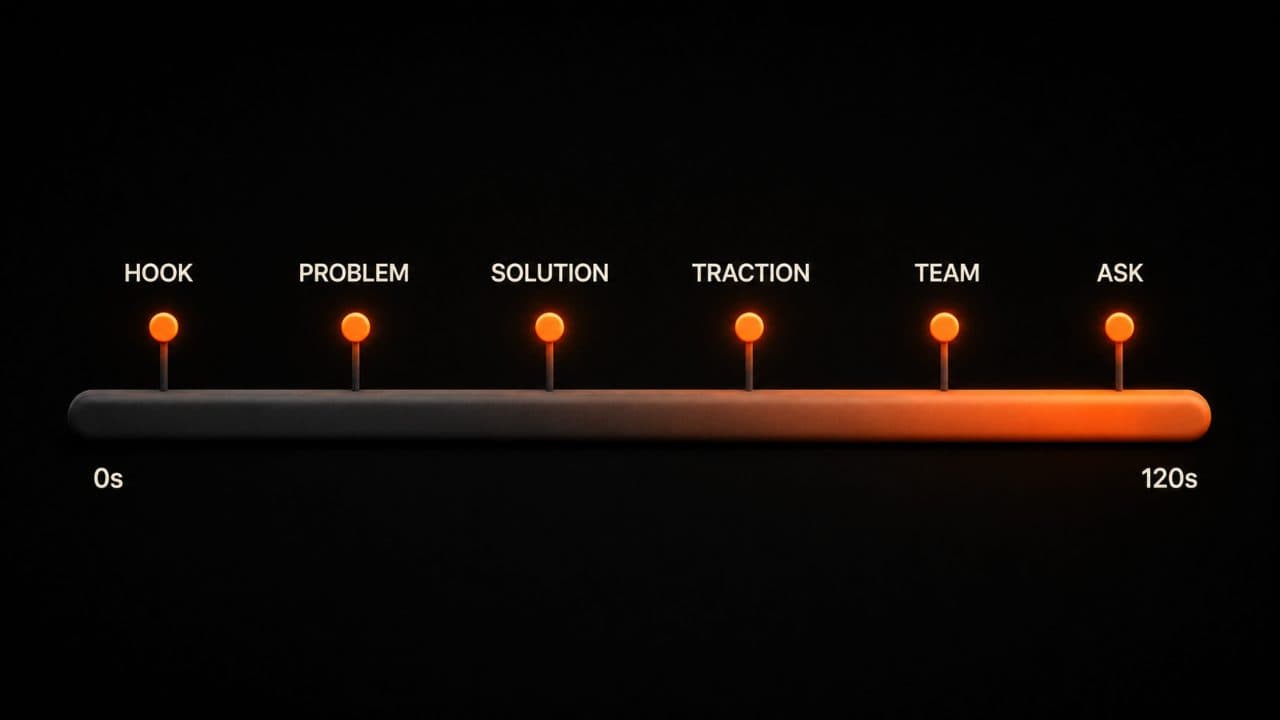
A pitch video isn't just a recording of you reading your deck. It's a story with a beginning, middle, and end. Here's what works.
The Hook (0-10 seconds)
Your first 10 seconds are critical. An investor has their finger hovering over the delete button. You have to grab them immediately.
The best hooks do one of three things: they identify a big problem that keeps investors up at night, they show surprising data that contradicts what investors assume is true, or they tell you what's in the next 90 seconds so you know it's worth watching.
Examples:
- "Every B2B sales team is leaving 40% of potential deals on the table."
- "We've grown 300% month-over-month in our first year. Here's why."
- "In the next 90 seconds, I'm going to show you why this market is about to explode, and how we're positioned to own it."
The Problem (10-30 seconds)
Now you have attention. Spend the next 20 seconds on the problem. Make it real. Don't say "communication is inefficient." Say "Sales reps spend 4 hours a day on email instead of selling. That costs a $1M company $150K a year."
Use a specific, measurable problem. Show the cost. Make investors feel the pain.
The Solution (30-60 seconds)
Introduce your product. Show how it solves the problem. Keep it simple, one sentence is ideal. "We automate email follow-ups so reps spend more time on calls."
Then show the proof. A 15-second product demo clip showing the product in action is worth 10 minutes of explanation.
Traction and Results (60-90 seconds)
Show what's actually happened since you built this. Revenue numbers. User growth. Customer wins. Retention metrics. Whatever shows momentum.
"We're doing $50K MRR with 200 active users and growing 30% month-over-month. Our customers are saving an average of 15 hours per week."
Specific beats vague. Always.
The Team (90-110 seconds)
Spend 20 seconds on why you're the right team to execute. Don't list CVs. Say what gives you an unfair advantage.
"I spent 10 years building sales infrastructure at Salesforce. My CTO scaled engineering at Stripe to 500 people. Together, we've hired the first 15 engineers, and we know exactly what we're building."
The Ask (110-120 seconds)
Close with clarity. What are you raising? What do you need? What's the next step?
"We're raising a $2M seed round. We're talking to a few funds, but we wanted to get in front of you first because of your track record in sales infrastructure. Are you available for a call next week?"
Keep the entire pitch video between 90 seconds and 2 minutes maximum. Investors respect your time awareness. Longer videos communicate that you can't edit ruthlessly, which is a warning sign.
Best tools for creating AI pitch videos
You don't need a film production company. You have options. Here's what's actually working.
DeepReel
DeepReel is built for exactly this use case, creating professional videos at scale without a production team. Upload a script, choose an AI avatar or use yourself on camera, and the platform generates a polished pitch video in minutes.
The advantage: speed and personalization. If you're sending pitches to multiple funds or investors, you can customize each one with the fund's name, the partner's interest areas, or specific details they care about. Then the video is personalized without you re-recording.
Pricing: $5/month (100 video credits), $25/month (1,000 credits), $30/month (3,000 credits). For a pitch that goes to maybe 20-50 investors, even the $5 plan covers you.
Synthesia
Synthesia uses AI avatars and text-to-speech to create professional videos from scripts. You type your pitch script, pick an avatar or upload your own likeness, and Synthesia generates the video. No camera. No editing. Done in minutes. If you're weighing Synthesia against other platforms, we compared the best Synthesia alternatives to help you decide.
The quality is impressive. Synthesia's realistic avatars can feel like a real person is presenting. The platform includes background customization, product demo clips, and subtitles in multiple languages.
Pricing is based on video length and output quality, starting around $30/month for individual creators.
Loom
Loom is the simplest option if you want to record yourself. Hit record, talk through your pitch, stop. Loom captures video, audio, screen recording, and webcam all at once. The interface is clean, and sharing is one click.
Downside: it's not AI-generated, so you're doing the recording yourself. But some investors actually prefer seeing a real founder on camera over an AI avatar. Loom is free to start; paid plans are $15/month.
Pitch.com
Pitch is a presentation tool that focuses on beautiful, animated decks. If you want to stick closer to the traditional slide format but add motion, transitions, and visual polish, Pitch creates decks that look premium and animate smoothly. You can record yourself presenting over the slides or export as video.
The advantage: you get the structure of a deck with the engagement of video. Pricing starts around $10/month per user.
BombBomb
BombBomb is built for personalized video outreach. Record one video and send it to many investors. The platform handles personalization (inserting names, custom thumbnails, tracking), so each investor feels like you recorded something just for them.
It's between full automation and manual recording, you record once, but the platform personalizes the delivery. Pricing is $20/month for individuals.
All of these tools solve the same core problem: turning a script into a professional video without needing a production team. Pick based on whether you want to appear on camera, use an AI avatar, or rely on slide-based presentation.
How to structure your pitch video outreach
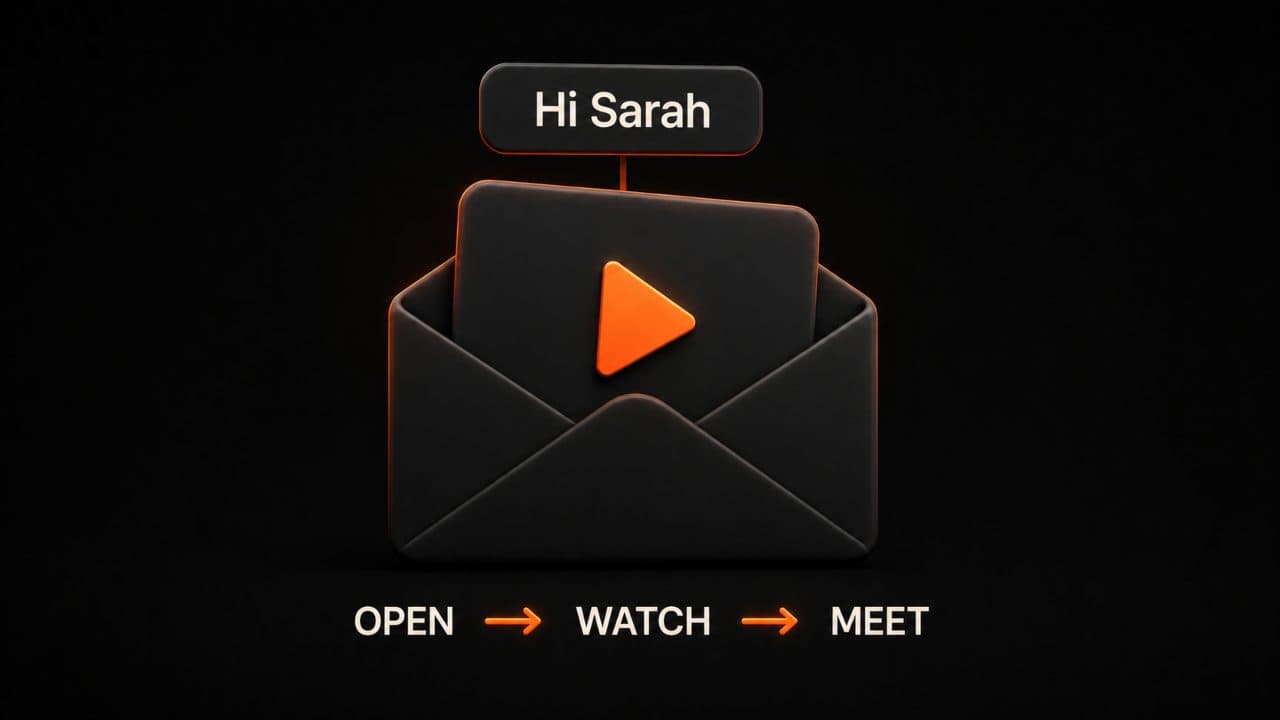
Creating a great video is half the battle. Distribution is the other half. Here's how to get it in front of the right investors.
Research First
Before you record a single pitch, know who you're talking to. Read the investor's fund thesis. Check their portfolio. Look at the companies they've backed and the stages they lead. Why do you want their money specifically?
This research changes your pitch. Instead of "we're raising $2M," you say "you've backed three companies in the MarTech space, and based on your track record with [Company A], we think you're the perfect lead for our round."
Personalize the Opening
If you're sending to specific investors, personalize the first 20 seconds of your video. Start with their name or their fund's name. Reference something they've done. "Hey [Name], I saw you led the [Series A] round for [Company]. We're doing something similar in [Space]."
This doesn't require 50 different videos. One good pitch video with 3-5 seconds of personalized opening that you can swap out before sending to each investor gets the job done.
Send via Email (Not LinkedIn)
Email gets opened more often than LinkedIn messages. Subject lines matter. Research shows that emails with "pitch" or "opportunity" in the subject line get higher open rates, but specificity wins, "Raising $2M Seed Round: We're Helping B2B Teams Close 30% More Deals" beats a generic subject.
Embed the video in the email or use an email service that supports inline video. Make sure it plays with one click. Don't make investors download anything or click through to a page.
Keep the Email Short
Your pitch video does the heavy lifting. The email should be 2-3 sentences max. "Hi [Name], I've been following [Fund] for a while and love what you've backed. This is us in 90 seconds. Would love to grab 15 minutes next week. Are you free?" Done.
Use a CRM to Track
If you're sending to multiple investors, use a CRM or email tracking tool to know who opened, who watched, how far they got into the video. This tells you if the pitch is landing or if you need to adjust the message.
Tools like HubSpot, Salesforce, or Pipedrive let you track email engagement and video watch time. Use this data to improve your pitch.
Follow Up With Context
If an investor watches most of your video but doesn't reply, send a follow-up. "I saw you watched our pitch, thanks. Quick question: is the [specific concern you addressed in the video] something you're thinking about right now?"
This shows you're tracking engagement and aren't just blasting emails. It personalizes the conversation.
Share on Your Website
Host your pitch video on your website's homepage or a dedicated investor page. If an investor wants to learn more about you (they Googled you, found your site, clicked around), seeing your pitch video is one of the best ways to get them context fast. Optimizing that page for search can bring in organic investor traffic too — our video SEO strategy guide covers how to make your video pages rank.
Use hosting like Vimeo or Wistia that lets you password-protect if you want, or keep it public. Add the video, then add supplementary documents below it: a one-pager, the pitch deck as a downloadable PDF, financial projections if appropriate.
Cold outreach: pitch videos beyond warm intros
Not every investor will take a warm introduction. Some you need to reach cold. A pitch video changes the math here.
Cold email normally gets 1-3% response rates. But cold email with video attached gets response rates between 5-15%, depending on the ask and the list quality.
Why? Because a cold video feels less robotic. It shows effort. When you're willing to spend 90 seconds recording yourself to pitch someone cold, it stands out.
Here's the process:
- Build a list of 50-100 investors who fit your stage and space.
- Record ONE pitch video that covers your core story. Keep it general enough that it works for all of them.
- Write a simple email with 2-3 sentences and a personalized opener ("I see you led the Series A for [Company], we're doing something similar").
- Send with your video embedded or linked.
- Wait a week. If no response, send a follow-up with a different angle. "Didn't hear from you on the last email. One thing we didn't mention: [new datapoint or customer win]."
- Try a second follow-up after another week.
Most investors won't respond. That's normal. But 5-10% response rate means if you hit 100 investors, you're getting 5-10 inbound meetings. That's real.
Distribution to VC firms and angels
Beyond email outreach, where else should your pitch video live?
Pitch Decks and One-Pagers
Include a link to your video in your pitch deck itself (slide 1 or 2). This works when you're already in a warm process and emailing a deck. Investors can either read it or watch you pitch it.
Your Investor Updates
If you're already a funded company, send pitch videos in your investor updates. Show new traction. Celebrate wins. Ask for intros. Video makes these updates memorable instead of boring email. You can also include video testimonials from customers to back up your traction claims.
AngelList and Seed Funding Platforms
Some platforms like AngelList let you upload videos to your company profile. This is free exposure to thousands of angels and micro-VCs. A strong pitch video here can generate inbound interest.
Industry-Specific Platforms
Depending on your space, there are niche platforms where investors hang out. B2B SaaS founders might use Product Hunt's launch pad or specific Slack communities. FinTech founders tap into FinTech-focused forums. Research where your investors congregate and get your video in front of them.
Your Social Media
Drop a 60-second clip of your pitch video on LinkedIn, Twitter, or YouTube. Not the full pitch, just the hook and problem. "Here's what we're building and why it matters in 60 seconds. Full pitch available on our website."
This builds awareness and filters to people genuinely interested. The ones who watch will either reach out or you can reach out to them with the full pitch.
Tips for compelling pitch videos
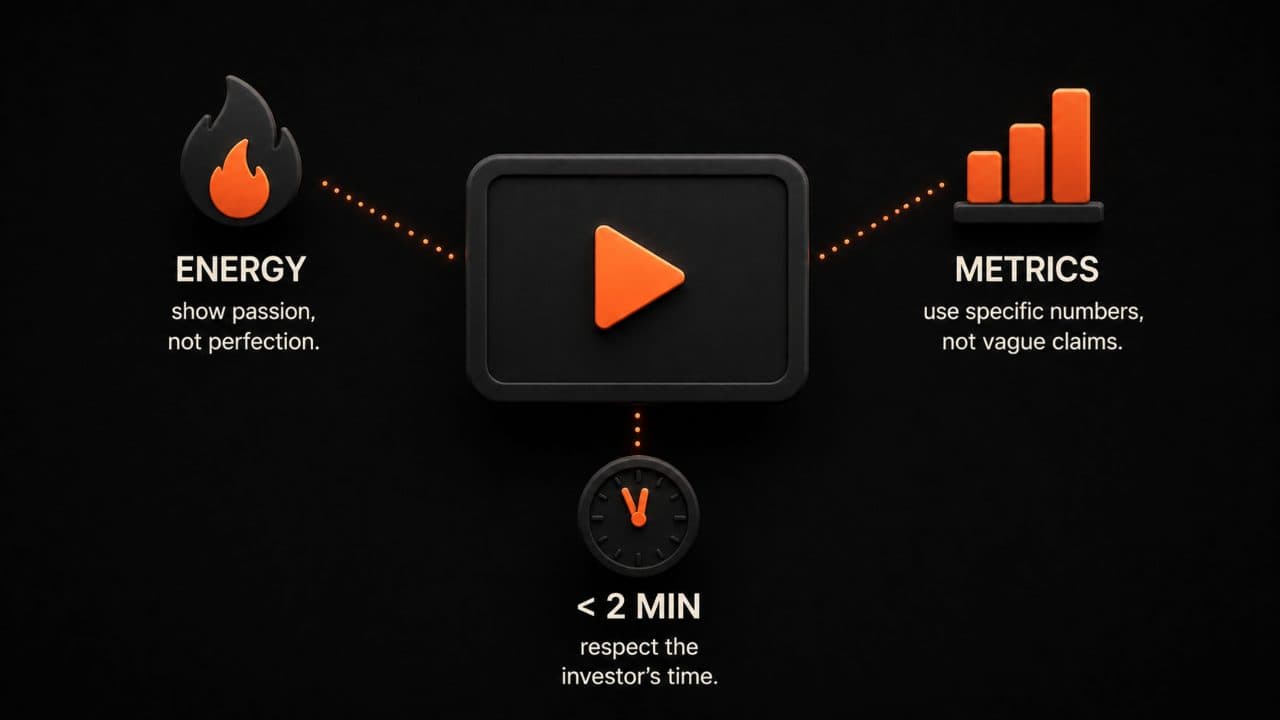
Beyond structure, here are tactics that make pitch videos actually good.
Show Energy, Not Perfection
Investors aren't looking for a polished news anchor reading a teleprompter. They want to see founder energy. Passion. Conviction. Show that you believe in this idea intensely.
Talk with your hands (if on camera). Vary your tone. Show emotion when talking about your customers or your mission. Let them see why you're obsessed.
Use B-Roll and Demo Footage
Don't just film yourself talking for 90 seconds. Cut in clips of your product, your customers using it, screenshots of results, clips from news coverage. Visual variety keeps engagement up and makes the pitch feel more dynamic.
A 15-30 second product demo is worth 60 seconds of explanation. Let the product speak.
Include a Specific Metric or Stat
Generic pitches blur together. Specific numbers stick. Instead of "we're growing fast," say "up 3x in the last six months" or "just hit profitability."
Instead of "customers love us," say "93% retention rate" or "our customer support team gets 4.8-star reviews."
Numbers are memorable and credible.
Speak to the Investor's Thesis
Show you understand why this investor should care. Reference one company in their portfolio. Mention why your space aligns with their strategy. In a 90-second video, 20 seconds of "I know who you are and why this matters to you" goes a long way.
Keep It Under Two Minutes
Every second beyond 90 seconds increases drop-off rate. If you're at 105 seconds, cut ruthlessly. If you're at 120 seconds, rewrite entire sections. Respect the investor's time. It's your first impression.
Get Direct Feedback
After you record your pitch video, send it to three people who know your business, a mentor, a founder friend, an advisor. Watch their reaction. Do they lean in? Do they seem confused? Do they have questions?
Use their feedback to tighten the message. Then record again.
A/B Test If Possible
If you're sending to a large pool of investors, record two versions with slightly different hooks or different calls-to-action. Track which one gets more watches and engagement. Then use the winner as your template going forward.
Common mistakes that kill pitch videos
Here's what doesn't work.
Too Long
A three-minute pitch video feels like a waste of time when an investor gets 10 per week. They'll click away at the 90-second mark even if your best stuff is coming. Shorter is always better.
No Clear Ask
You show your product. You show traction. But then... what? What do you want the investor to do? "Let's grab coffee" is vague. "I'd like to send you our full deck and schedule a 20-minute conversation for Thursday or Friday" is clear.
Talking Faster Than Your Brain Can Keep Up
Nervous founders rush their delivery. They speak at 140 words per minute instead of 100. The investor can't follow. Slow down. Pause. Let important ideas breathe.
No Subtitles
Many investors watch videos on mute (in their office, on their phone). If you don't have subtitles, they can't follow the core message. Subtitles also improve accessibility. Every platform now makes subtitles easy to add — here's how to add subtitles to any video with AI.
AI Avatar Without Personality
Some founders record pitch videos with AI avatars because it's faster. That's fine. But a flat, emotionless avatar reading a script is worse than no video at all. If you use an avatar, add graphics, B-roll, and enthusiasm to the script so the video feels alive. Choosing the right AI character for your video makes a big difference in how your pitch lands.
Generic Pitch, Not Investor-Specific
Sending the exact same pitch video to 50 different investors is lazy. Even a tiny bit of personalization, "Hey [Name], I saw you backed [Company], and we're building something similar...", dramatically improves response rates.
Poor Lighting and Audio
Investors notice bad production quality. It's the first thing that makes them doubt you. You don't need professional lighting, but you need natural light or a basic ring light. You don't need studio audio, but you need audio that's clear with no background noise.
Test your setup before recording. If you sound like you're in a tunnel or your face is in shadow, redo it.
Not Following Up
You send a pitch video. If there's no response, move on. Wrong. Send a follow-up. The investor might have missed it. Their email might be overflowing. A follow-up with a different angle ("Didn't hear from you, since we last emailed, we hit $X in MRR") keeps you in play.
Follow up 2-3 times before giving up.
FAQ
Should I show my face or use an AI avatar?
Both work, but founder-on-camera wins in early-stage investing. Investors want to see you. They want to assess your credibility, your communication skills, your passion. If you're camera-shy, that's fine, practice. Or use an avatar for cold outreach and then do face-to-camera follow-ups with interested investors.
How many investors should I send pitch videos to?
Start with 20-30 warm outreach attempts. If you get a 20% response rate (4-6 meetings), your pitch video is working. If you get zero meetings, record a new version and try 20 more. Once you find a format that works, scale to 50-100 cold emails for your seed round.
Should I mention pricing or business model in a 90-second pitch?
Not unless it's a major differentiator. Your job in 90 seconds is to get a meeting. Once you're in the room or on a call, you go deeper into your model, pricing, timeline, and financial projections.
Wrap up
A pitch video shows investors who you are, not just what you're building. The structure is simple: problem, solution, traction, team, ask. Keep it under two minutes.
Record your first AI pitch video this week with DeepReel. Send it to 20 investors. Track the response rate. Adjust based on what performs. Plans start at $5/month.